Mirleft, 2008: where this material comes from
People often ask how you invent a material. In my case there was no invention: a village with no electricity in the streets, a great many newspapers, an oil mill, and two years of getting it wrong.
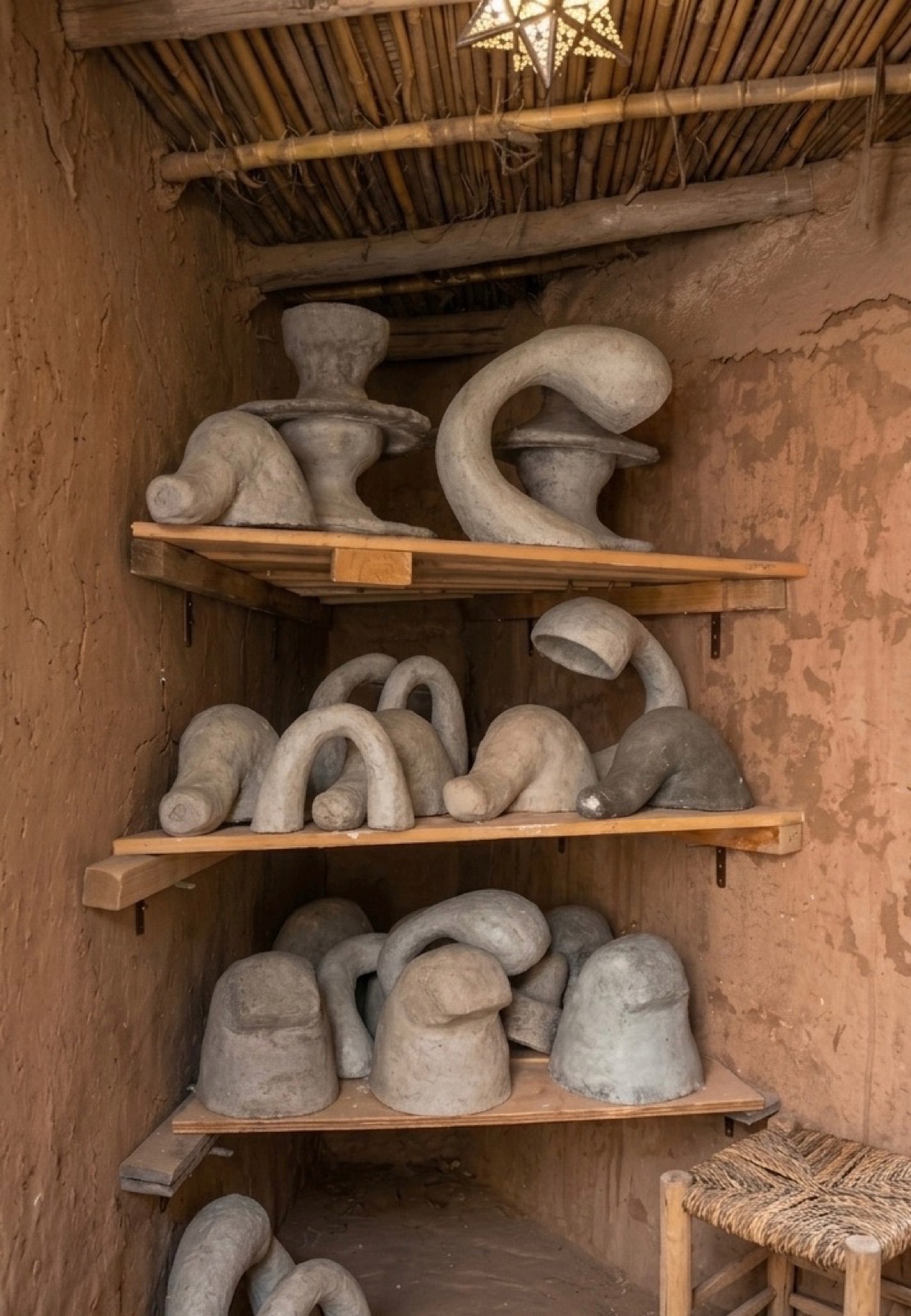
2008
Mirleft
Mirleft is a village in southern Morocco. In 2008 there was no tarmac road and no electricity in the streets. There were, on the other hand, newspapers everywhere: in the cafés, on the stalls, wrapped around things.
I was looking for a material to work with that needed no kiln, no machine and no delivery. The paper was there, free, in quantity. What remained was to make it usable.
The mill
Having paper ground at the oil mill
There was no paper grinder in the village. There was an oil mill. I had my newspapers ground there, and that is where I understood something I still watch today: the fineness of the grind changes everything. Too fine and the paste turns smooth and characterless. Too coarse and it does not hold.
My newspapers are still dry-ground, now by a company near Béziers, and I choose the grain size. It is the one setting I have never delegated.
The useful failure
Paper and glue alone do not hold
The first pieces were strong and wrong. Strong, because paper and glue make a tough material. Wrong, because they warped as they dried: a shape drawn straight came out twisted, and no piece looked like the one before.
For a sculpture that is no problem. For what I wanted to do — objects that can be made again, in small consistent runs — it was a dead end.
2010
Marrakech, and plaster
It was in Marrakech that I added plaster to the paper pulp. The paste became strong enough to take the imprint of a mould and hold it. I learned to make my own silicone moulds — the first ones with dental silicone, for want of anything better — and I drew the first Invider lamps.
They went to Paris, to Fleux and then Merci, to New York, to Breuckelen Berber, and to Los Angeles, to Objet LA NY. That is the moment a piece of research became a trade.
Béziers
The old mirror factory
The workshop is now in Béziers, in my family’s old mirror factory. The recipe still comes from Mirleft: salvaged paper, a mineral binder, a plant-based glue, and a refusal to add anything that serves no purpose.
What it has become exactly, I explain here: papier-mâché, recycled paper, MoldingPulp.